From a Paper Checklist to an App the Whole Shop Uses
A family-owned beverage store closed on paper and a spreadsheet for a decade. Here is how that became a tablet app every closer uses, what we got wrong on the first try, and what changed for the owner.
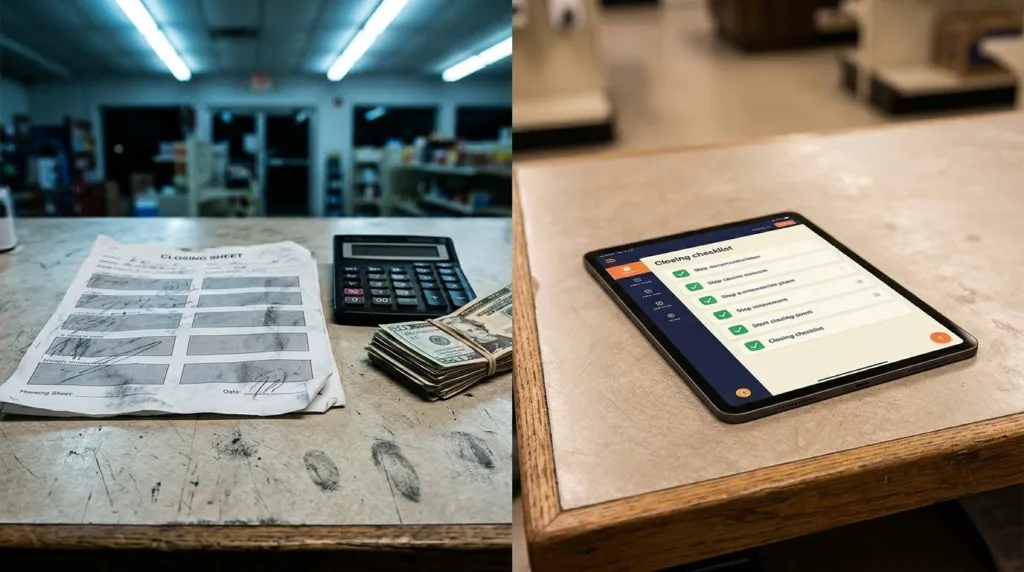
There is a sheet of paper taped to the counter of a lot of small businesses. It has boxes for the register count, the deposit, the safe, maybe a line for "notes." It has been photocopied so many times the boxes are grey. Everybody knows the sheet. Nobody loves it.
This is the story of one of those sheets, at a family-owned beverage store in Northeast Ohio, and how it turned into an app the whole shop uses every night. I am telling it because the interesting part is not the code. It is how little we changed about the way the work gets done.
What the close looked like
Every night, whoever was closing counted the drawers, wrote the numbers on the sheet, did the arithmetic by hand or on a phone, put the cash in the bag, and left the sheet for the morning. Then, some mornings, the owner typed those numbers into a spreadsheet that had been started in 2015 and had grown a tab a year since.
It worked. It had worked for a decade. It also had three problems that showed up every week.
The math was done by a tired person at eleven at night. Not often wrong, but wrong often enough that the morning started with a hunt.
Every closer closed a little differently. One counted the safe first. One wrote the deposit before the drawers. The sheet allowed it, so the numbers did not always mean the same thing.
The owner saw the numbers when the owner got to the store. If something was off on Saturday, it was found on Monday.
None of that is a disaster. It is a slow tax, an hour here and a worry there, paid every single day.
What we did not do
We did not design a new closing process. This matters, so I will say it twice: the staff already had a process they trusted. The sheet, for all its grey boxes, encoded ten years of knowing what to count and in what order. Our job was to put that process on a screen, not to replace it with ours.
So the first thing we built was not an app. It was a list. We sat with the owner and a closer and wrote down every step on the sheet, in the order the best closer did them, and what the answer to each step depended on. Where the two of them disagreed, we asked which order produced fewer mistakes, and that became the order.
What we built
A tablet lives by the register now. At close, the closer taps their name, and the app walks them through the steps in the agreed order. Count this drawer. Count that one. Here is what the register says you should have. Here is the difference, already worked out. Here is the deposit, already totaled. Add a note if something was odd. Done.
The math is gone from the human's job. The order is the same every night no matter who is closing. And when the closer taps Done, the owner's phone has the numbers, from the couch, before the alarm is set.
Behind the scenes it is quieter than it sounds. The app pulls the register's expected totals from the point of sale, so nobody types those in. It keeps every close so the spreadsheet is finally retired, not replaced by a spreadsheet with a nicer font. Each person signs in as themselves, so the owner can see who closed and a new hire sees nothing they should not.
What we got wrong first
The first version asked for everything at once: all the drawers on one screen, all the totals updating live. It looked great in a demo. In the store, at eleven at night, with a drawer of cash open, it was too much to look at. A closer told us, politely, that the paper had been easier.
That was the most useful sentence in the project. We rebuilt the close as one question per screen. Count this. Next. Count that. Next. It is less impressive to look at and far better to use. If you are ever shown a mock-up of an app for your business and it looks busy, ask to see what the newest employee sees at the end of a long shift.
What changed
The morning hunt is over, because the arithmetic is done by the app and the owner already knows if a number is off. The close takes about the same time it did, but it ends with a finished record instead of a piece of paper. New staff learn the close on their first night, because the app is the training. And the owner has ten years of closes in one place for the first time, which turned out to be worth more than anyone expected when a question came up about a slow month.
We have since added small things as the store asked for them. That is the normal life of a business app. The first version does the one job; the care plan keeps it running and lets it grow as the business does.
If you have a sheet like this
You probably do. It may not be a closing sheet. It may be a job ticket, an intake form, a delivery log, a checklist for opening the kitchen. The signs it is ready to become software are the same ones this store had: a human doing math that a machine should do, a process that depends on who is working, and an owner who finds out late.
An app like this one is the smaller end of what we build. The pricing page has the range, and the Business Apps page explains what you get. Or bring the sheet to a free call and we will tell you honestly whether it is an app, a cheaper tool, or a better sheet.
Key takeaway
The best business app is the one that matches how the work already happens. We did not invent a new closing process; we put the one the staff already trusted on a screen, took the math off their hands, and gave the owner the numbers in the morning.
Keep reading
More for local business owners
-
What a Custom Business App Actually Costs (and When a $30 Tool Is the Right Answer)
What drives the price of a custom app, what you get for it, and the honest test for when an off-the-shelf tool is the smarter buy.
-
Why We Moved Our Own Site Off WordPress (and When You Shouldn't)
What pushed us off WordPress for our own site, what we gave up, and who should absolutely stay on it.
-
The Power of Local Influencers: How to Find and Collaborate with Local Influencers for Your Business
Find and collaborate with local influencers to reach your target audience authentically and affordably without blowing your small business marketing budget on big celebrity endorsements.